

B Lab's new standards replace the 80-point score with minimum requirements across seven Impact Topics, phased in at Year 0, 3 and 5 and scaled by company size.
B Corp Impact Topics: What the Seven New B Lab Standards Ask of UK Businesses
B Lab's new standards replace the 80-point score with minimum requirements across seven Impact Topics, phased in at Year 0, 3 and 5 and scaled by company size.
B Corp Impact Topics: The 7 New B Lab Standards Explained
Published on
November 19, 2026
Contributors

James Pravato

Includability
Inclusive Community
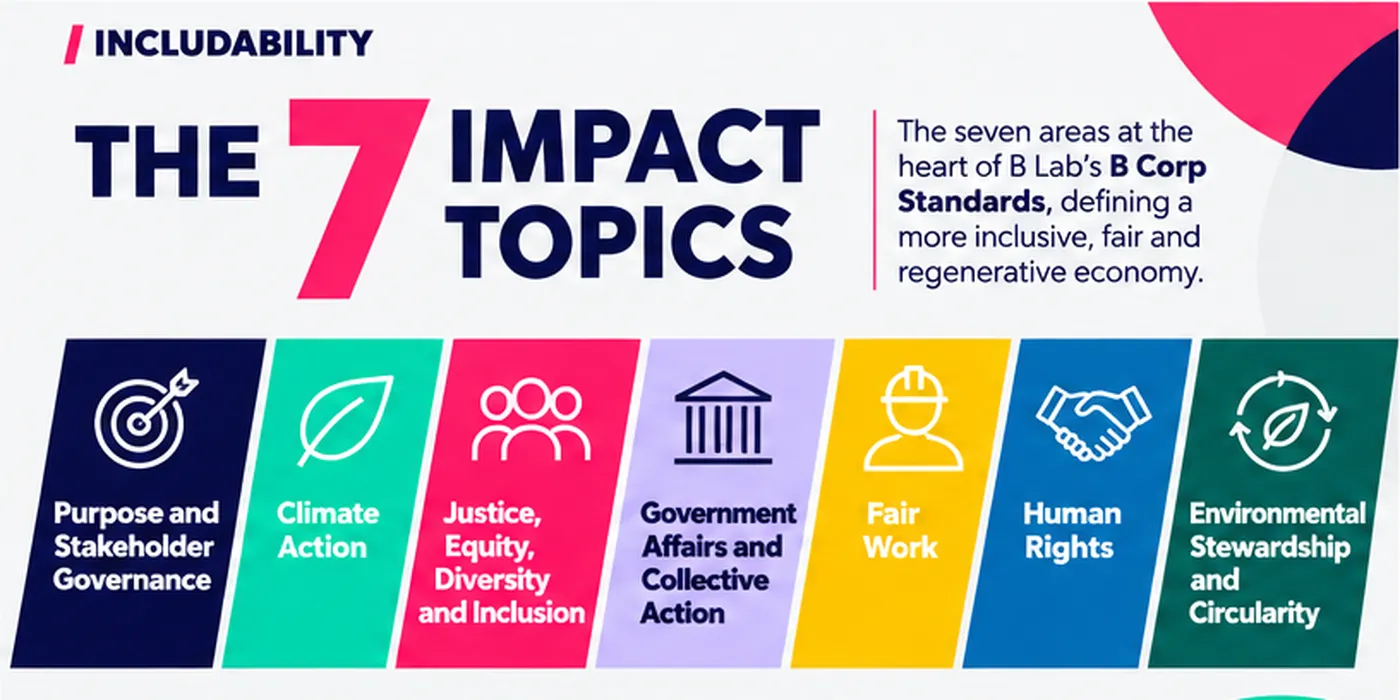
Table of Content
Key takeaways
↳ B Lab published its new B Corp standards on 8 April 2025, replacing the 80-point B Impact Assessment threshold with minimum requirements across seven Impact Topics [1].
↳ Since February 2026, existing B Corps have been recertifying against the Year 0 requirements of B Lab Standards V2.1, on a five-year cycle with further requirements added at Year 3 and Year 5 [3].
↳ B Lab UK announced the first 18 UK businesses certified under the new standards on 2 September 2026, as the UK B Corp community passed 3,000 companies [2].
↳ Under the JEDI Impact Topic, every company with workers chooses two JEDI actions at Year 0, rising to between three and seven actions by Year 3 depending on size, according to B Lab's JEDI summary for Standards V2.1 (August 2025) [6].
↳ Under Fair Work, Small companies and above must have a policy of not asking job applicants for their salary history, and must measure workplace culture regularly, from Year 0 [7].
↳ Large companies and above must calculate their gender wage gap from Year 0 under Fair Work, and Extra Large companies must also publish it [7].
B Corp Impact Topics: UK Guide to the New B Lab Standards 2026
B Lab's new standards are the biggest change to B Corp certification since the movement began. They took four years to develop, went through two public consultations and drew 26,000 pieces of feedback, according to Judy Rodrigues, B Lab Global's Director of Standards, speaking at the launch in April 2025 [1].
The UK has the largest B Corp community in the world. B Lab UK put it at more than 3,000 companies in September 2026 [2]. B Lab UK's Take 10 report, published in November 2025, found UK SME B Corps grew turnover by 20% between 2024 and 2025, against 3% for all UK SMEs, and grew headcount by 11% against 2% [13].
What the seven B Corp Impact Topics are
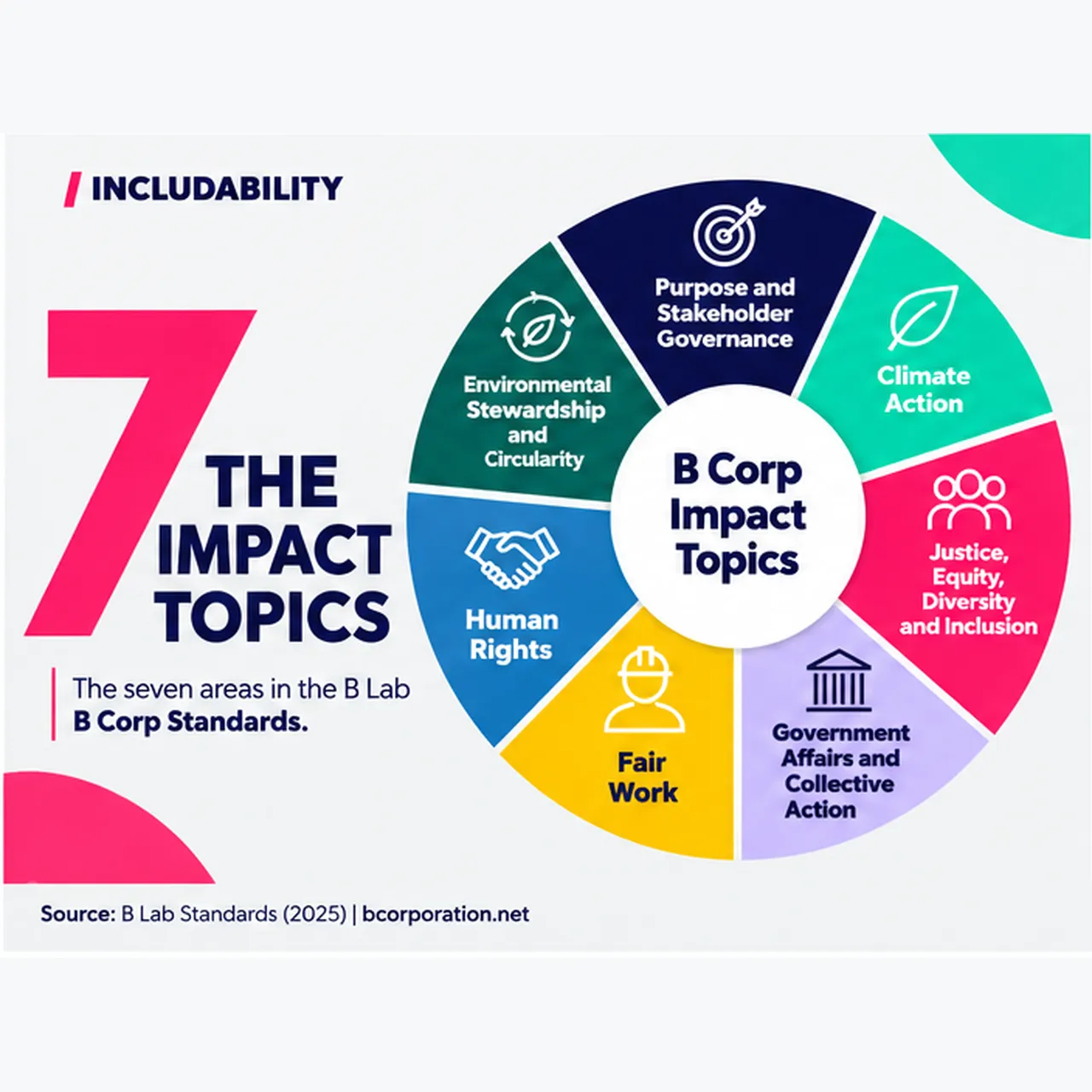
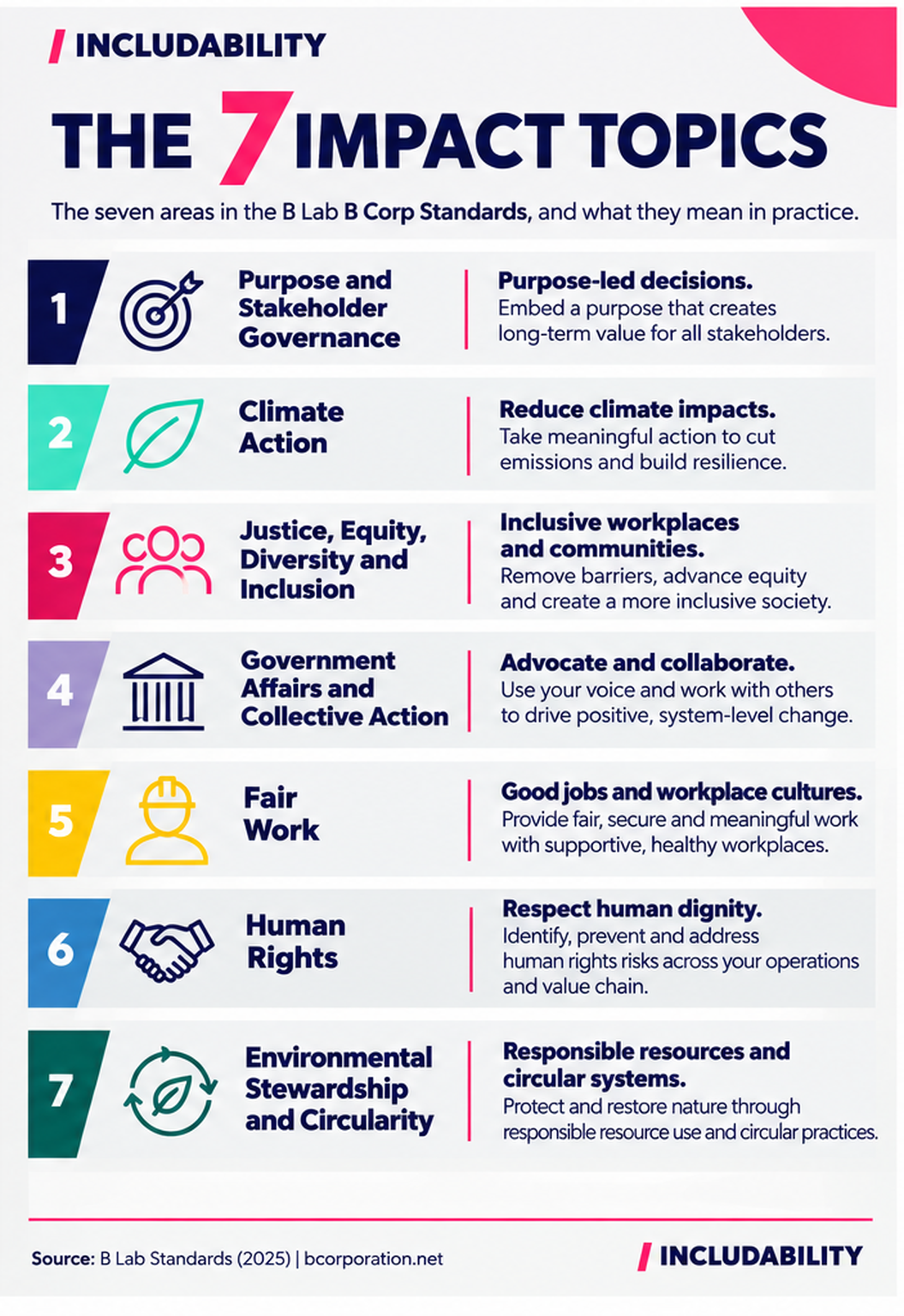
The B Corp Impact Topics are the seven areas in which every Certified B Corp now has to meet minimum performance requirements: Purpose and Stakeholder Governance, Justice, Equity, Diversity and Inclusion (JEDI), Fair Work, Human Rights, Climate Action, Environmental Stewardship and Circularity, and Government Affairs and Collective Action [1].
They sit on top of a set of Foundation Requirements. Those cover eligibility, legal accountability and a risk profile, and B Lab uses them to confirm a company can certify and to tailor which Impact Topic requirements apply [18].
What has changed from the old B Corp scoring system?
Under the old model, a company needed 80 points on the B Impact Assessment, and it could earn them wherever it was strongest. A high score on environment could carry a low score on workers. B Lab has replaced cumulative points with minimum requirements in every topic, so a strong area can no longer cover for a weak one [1].
Three other things have changed alongside it.
↳ Independent audit. Certification decisions are now made by B Lab-approved third-party assurance providers rather than by B Lab's own team, with the depth of audit scaled to the company's size and complexity [2]
↳ A five-year cycle. Companies certify against Year 0 requirements, then take on further requirements at Year 3 and Year 5, with follow-up audits at 12, 24 or 36 months from the certification date [3]
↳ Claims that hold up. B Lab UK presents the new standards as consistent with the EU's Empowering Consumers for the Green Transition Directive and with Advertising Standards Authority guidance on evidence-based claims [2]
The timeline in the UK ran like this. Existing B Corps began recertifying on B Lab Standards V2.1 in early 2026, new companies could certify from March 2026, and the first UK cohort under the new standards was announced on 2 September 2026 [3] [19] [2]. B Lab UK has frozen its fees through 2026 to help companies through the move [18].
How company size and Year 0, 3 and 5 decide what applies to you
The seven topics are the same for everyone. What changes is how many sub-requirements apply and how demanding they are.
B Lab sorts companies into size bands: companies without workers, Micro, Small, Medium, Large, Extra Large and Extra Extra Large, based on worker numbers and revenue [5]. In November 2025 B Lab changed how the band is chosen. It used to take whichever of revenue or headcount gave the higher band, and it now places companies in the lower one, which B Lab says will save more than 2,500 B Corps, many of them SMEs, money on verification [17].
The year matters just as much. To certify, a company meets its Year 0 sub-requirements. At Year 3 it keeps meeting those and adds the Year 3 ones, and at Year 5 it adds the Year 5 ones on top [4]. That means a plan made for Year 0 needs to look five years ahead.
There's some room for context. Under B Lab's equity mechanism, companies in countries with operational barriers can opt out of a set number of eligible sub-requirements, for example three at Year 0 for a Small company. B Lab's knowledge base says companies in countries with fewer barriers must meet everything that applies, and an update to the mechanism takes effect on 1 January 2027 [5].
What does each of the seven B Corp Impact Topics require?
The detail below covers what applies to small and medium-sized businesses at Year 0, with the main step up for larger companies. It isn't a full checklist. Your own requirements depend on size, sector and risk profile, and they're set out for your company in B Impact.
1. Justice, Equity, Diversity and Inclusion (JEDI)
B Lab's aim for JEDI is inclusive, diverse workplaces and a real contribution to fairer communities [1]. The topic has two parts, collecting data and taking action, and both parts need evidence an auditor can check.
JEDI1, collecting data. From Small upwards, companies collect data to inform their JEDI actions from Year 0. In practice that means an anonymous, voluntary worker survey or, for smaller teams, a facilitated discussion. Large companies and above add data on one more social identity, chosen with stakeholder input, from Year 3 [6]. Companies without workers and Micro companies don't have to meet JEDI1 [12].
JEDI2, taking action. Companies choose actions from a list of 19, grouped into three sets. The number depends on size and year, according to B Lab's JEDI summary for Standards V2.1 (August 2025) [6].
↳ Companies without workers: one action at Year 0, 3 and 5
↳ Micro: two at Year 0, three at Years 3 and 5
↳ Small: two at Year 0, four at Years 3 and 5
↳ Medium: two at Year 0, five at Years 3 and 5
↳ Large: two at Year 0, six at Years 3 and 5
↳ Extra Large and Extra Extra Large: two at Year 0, seven at Years 3 and 5
The three sets are worth knowing, because the choice is yours [6].
↳ Foundation: a public JEDI commitment, building leaders' JEDI knowledge, reviewing policies through a JEDI lens, diversity on the board and executive team, and an equity audit
↳ Within the workplace: employee resource groups, inclusive hiring, sponsorship and mentoring, an inclusive language guide, increasing representation of underrepresented groups, paid leave beyond the legal minimum, and accessible internal communication tools
↳ Beyond the workplace: an accessible website, publishing your JEDI plan and progress, supplier diversity, an inclusive external communications guide, assessing or redesigning a product or service for inclusion, and joining a JEDI collective action
From Small upwards, actions have to be chosen using data and stakeholder feedback and recorded in a plan [6]. That's the part that catches people out. Two good actions with no data behind them and no written plan won't meet the requirement.
Pick actions you can keep going. B Lab's guidance says actions carry across Years 0, 3 and 5 as long as they stay active and relevant, and some, such as keeping your website accessible, have to be met continuously [12].
2. Fair Work
Fair Work is about good quality jobs and positive workplace cultures [1]. B Lab brought two earlier draft topics, fair wages and workplace culture, together into one, and moved supplier requirements across to Human Rights, so Fair Work now covers a company's own workers [12]. It has four parts, and B Lab's Fair Work summary sets out who has to do what [7].
↳ Clear expectations. Every company gives workers a signed contract or offer letter. From Small upwards, cancellation periods for variable schedules have to be equal on both sides
↳ Fair wages. Every company tells workers how pay is set and what benefits they get. From Small upwards, a company has a policy of not asking applicants for their salary history. By Year 3, every company puts fair wage practices in place for its lowest-paid employees, such as paying a living wage
↳ Worker voice. From Small upwards, companies show they consider worker feedback in decisions. Extra Large companies and above need an employee representation mechanism by Year 3
↳ Workplace culture. From Small upwards, companies measure workplace culture regularly from Year 0, and have a plan to keep improving it from Year 3
B Corps were already ahead on pay before the new standards. B Lab UK's Take 10 report (November 2025) found UK B Corps were 26% more likely than comparison businesses to pay a family living wage to all workers [13].
The step up for Large companies is mostly about pay and data. They calculate their gender wage gap from Year 0, publish wage scales from Year 3, and close, reduce or justify the gap by Year 3. They also break culture results down by gender identity or sex at birth, and by one more social identity, from Year 3. Extra Large companies publish their gender wage gap and evaluate equal pay for work of equal value [7].
For UK employers with 250 or more staff, the gender wage gap calculation will feel familiar from statutory gender pay gap reporting. The difference is that B Lab expects you to act on it and, at Large size and above, to close, reduce or justify it [7].
3. Purpose and Stakeholder Governance
This topic asks companies to act on a defined purpose and build stakeholder governance into decisions, with governance structures that monitor purpose and performance [1]. For most SMEs that means being clear who your key stakeholders are, how you engage them and how they can raise concerns, rather than writing a new purpose statement. Large companies and above also identify material topics that the B Lab standards don't cover, set at least one SMART target for each and report progress every year [21].
4. Human Rights
Human Rights asks companies to understand where their operations and value chain could be linked to harm to people, and to act to prevent and reduce it [1]. It applies to service businesses as well as manufacturers. At Year 0, Micro and Small companies make a public commitment to respect human rights. Medium companies outside the service sector with a minor footprint identify their salient human rights issues, and Large companies and above have a public human rights policy [8].
5. Climate Action
Smaller companies aren't asked to start by measuring their full greenhouse gas emissions. From Year 0, companies without workers, Micro, Small and Medium companies have a publicly available climate action plan, and from Year 3 they show progress against it [9]. Larger companies measure emissions, set validated science-based targets and, at Large size and above, publicly report progress on a transition plan [1] [9].
6. Environmental Stewardship and Circularity
This topic covers natural resources, waste, biodiversity and circular practice, asking companies to assess their environmental impacts and act to reduce them across operations and value chain [1]. What applies depends heavily on your sector and footprint, so a professional services firm and a manufacturer will see very different requirements in B Impact.
7. Government Affairs and Collective Action
Every company needs a public responsible lobbying policy from Year 0, even if it has never lobbied [11]. Small companies also take part in at least one collective action at Year 0, rising to two by Year 3, to advance a social or environmental outcome [10]. The largest companies publish country-by-country tax reports [1].
Which B Corp Impact Topics depend on your people data?
Four of the seven, JEDI, Fair Work, Purpose and Stakeholder Governance and Human Rights, depend on knowing who works for you and what they experience. JEDI and Fair Work rely on the same evidence more than any others.
One well-run worker survey can answer several requirements at once. It can give you the JEDI1 data on who your people are, the Fair Work measurement of workplace culture, the evidence that you consider worker feedback, and, at Large size, the culture results broken down by social identity [6] [7]. Run separately, those become three or four surveys, and people get tired of answering them.
The same goes for plans. A JEDI action plan built from your data and stakeholder feedback is a requirement in its own right from Small upwards, and it's also where your Fair Work culture improvement plan can live from Year 3 [6] [7].
B Corp Impact Topics in practice: Tyler Grange
Tyler Grange is an environmental consultancy working in ecology, arboriculture and landscape planning, with more than 100 people across offices from Exeter to Leeds [16]. It's also an Includability Committed Employer, and the business whose Cultural Roadmap has helped support their B Corp and pupose-led culture.
Tyler Grange certified as a B Corp in November 2022 with a B Impact Assessment score of 91.3, led internally by its Quality and Data Manager, Kay Geoghegan [15]. In the same year it was one of the first 60 companies in the UK four-day week pilot [16].
In its first impact report, published in December 2023, Tyler Grange set itself a public target of scoring above 100 when it recertified, and named the areas it would work on, including employee volunteering, sustainable operations and a supply chain that now includes 20 fellow B Corps [20]. Its current listing in the B Corp directory shows an overall score of 120.3 [14].
That habit of publishing a target, naming the work and reporting back is close to what the Year 0, 3 and 5 model now asks of every B Corp. Tyler Grange's directory listing shows it is still certified on the previous standards, so its next recertification will be against the Impact Topics [14].
Five B Corp Impact Topic actions for this quarter
- Find out exactly which sub-requirements apply to you. Complete the Foundation Requirements and risk profile in B Impact, confirm your size band and sector, and export your Year 0 list. Do it this month, because everything else depends on it.
- Map what you already do against all seven topics. Record where each existing policy, survey or report sits, and mark the gaps. Aim to finish within six weeks.
- Run one worker survey that does several jobs. Design it once to cover JEDI1 data collection, Fair Work culture measurement and worker feedback, anonymous and voluntary, and plan to repeat it every year. Get it out before the end of the quarter.
- Choose your Year 0 JEDI actions from the data, and write them into a plan. Name an owner and a date for each, and pick actions you can sustain through Year 3, when the number rises. Sign the plan off at board or leadership level this quarter.
- Put the quick policy wins in place. A public responsible lobbying policy, a no-salary-history policy for recruitment, written contracts or offer letters for everyone, and a public climate action plan if you're Small or Medium. Most of these are a few days' work each.
The B Corp Impact Topic evidence to keep for your audit
Certification now depends on what an independent auditor can see, and you'll be audited again during the five-year cycle [3]. Keep the evidence in one place, dated and owned.
↳ JEDI: the survey or discussion method and results, your JEDI action plan with the data and feedback behind each choice, and proof each action is happening
↳ Fair Work: contracts or offer letters, the no-salary-history policy, how you tell people their pay is set, culture survey results year on year, and examples of decisions changed by worker feedback
↳ Purpose and Stakeholder Governance: your stakeholder map, how you engage each group and your route for raising concerns
↳ Human Rights: your public commitment or policy and, at Medium size and above, how you identified your salient issues
↳ Climate, environment and collective action: your public climate action plan and progress against it, your responsible lobbying policy, and a record of the collective action you took part in and what it achieved
The same evidence is useful well beyond B Corp. When a board, an investor or a client asks about your workforce data, pay or inclusion, a dated evidence pack answers them without starting again.
B Corp Impact Topics FAQ
What are the seven B Corp Impact Topics?
They are Purpose and Stakeholder Governance, Justice, Equity, Diversity and Inclusion, Fair Work, Human Rights, Climate Action, Environmental Stewardship and Circularity, and Government Affairs and Collective Action. Every B Corp has to meet minimum requirements in all seven [1].
Is there still a B Corp score of 80?
No. B Lab has moved away from cumulative point scoring, so companies show they meet the Year 0 requirements that apply to them rather than reaching a target score [3].
When do existing UK B Corps move to the new standards?
At their next recertification. Existing B Corps have been recertifying against Year 0 of B Lab Standards V2.1 since February 2026 [3].
What do Year 0, Year 3 and Year 5 mean?
Year 0 is what you meet to certify. At Year 3 and Year 5 you keep meeting everything from earlier years and add a further set of requirements on top [4].
How many JEDI actions does a small business need?
Two at Year 0, according to B Lab's JEDI summary for Standards V2.1. A Small company then needs four by Year 3, and a Micro company three, chosen using data and feedback and recorded in a plan from Small upwards [6].
Do Micro companies have to collect JEDI data?
No. Companies without workers and Micro companies are exempt from the JEDI data requirement, though they still choose and carry out JEDI actions [12].
Do B Corps have to pay the living wage?
Not at Year 0. By Year 3, every company puts fair wage practices in place for its lowest-paid employees, and paying a living wage is one of the options [7].
Does a small company need to measure its carbon emissions?
Not at first. Companies without workers, Micro, Small and Medium companies need a publicly available climate action plan from Year 0, while larger companies measure emissions and set science-based targets [9] [1].
Who decides whether a company is certified now?
An independent, B Lab-approved third-party assurance provider, with the audit scaled to the company's size and complexity [2].
Where Includability fits
JEDI is the Impact Topic where the new standards ask for the most visible change in how the work is done. You need data on your people, actions chosen from that data, a written plan and evidence that it's happening, and the number of actions rises at Year 3. Plenty of B Corps are committed to inclusion and still don't have that order of work in place.
The JEDI Toolkit is built for exactly that. It's a guided, self-paced toolkit on the Includability Academy with eleven sections, covering everything from your Self-ID Survey and data approach to your JEDI action plan, inclusive hiring, policy and communication. Each section names the JEDI criteria it supports and produces a document you keep as evidence, and the same data carries into Fair Work. B Lab makes the certification decision. The toolkit helps you get ready for it.
Find out more and get started at incademy.co.uk.
About Includability
Includability | B Corp is a UK workplace culture business and a B Corp with a score of 143.2 ourselves. We partner with organisations to build inclusive, diverse, mentally healthy, evidence-based workplace cultures through Cultural Roadmaps, working as a strategic partner to the board, a trusted colleague to the people doing the work, and a community of more than 100 Committed Employers and Partners who learn from each other. We sit alongside you, not over you: B Lab sets and audits the standard, and we help you build the culture and the evidence behind it.
Sources and references
- B Lab Global, B Lab publishes new B Corp standards, raising the bar for businesses worldwide, 8 April 2025. bcorporation.net
- B Lab UK, First UK companies certify as B Corps under B Lab's most ambitious standards yet, 2 September 2026. bcorporation.uk
- B Lab U.S. and Canada, Guide to B Corp Recertification, 2026. usca.bcorporation.net
- B Lab Global knowledge base, Changes to the B Lab's New Standards. kb.bimpactassessment.net
- B Lab Global knowledge base, How are the new B Lab Standards requirements tailored to each company's context?, size and opt-out tables effective November 2025. kb.bimpactassessment.net
- B Lab Global knowledge base, Impact Topic Summary for Justice, Equity, Diversity and Inclusion, Release 2, 25 August 2025, B Lab Standards V2.1. kb.bimpactassessment.net
- B Lab Global knowledge base, Impact Topic Summary for Fair Work, B Lab Standards V2.1. kb.bimpactassessment.net
- B Lab Global knowledge base, Impact Topic Summary for Human Rights, B Lab Standards V2.1. kb.bimpactassessment.net
- B Lab Global knowledge base, Impact Topic Summary for Climate Action, B Lab Standards V2.1. kb.bimpactassessment.net
- B Lab Global knowledge base, Impact Topic summary for Government Affairs and Collective Action. kb.bimpactassessment.net
- B Lab Global knowledge base, GACA1.1: How to write a responsible lobbying policy. kb.bimpactassessment.net
- B Lab Global, B Lab's New Standards Impact Topic: Justice, Equity, Diversity, Inclusion (JEDI) and B Lab's New Standards Impact Topic: Fair Work, 2025. JEDI, Fair Work
- B Lab UK, Purpose-led businesses thriving and outperforming UK peers, new data shows, on the Take 10 report, 10 November 2025. Based on B Impact Assessment data from UK B Corps and comparison businesses, 2019 to 2025, and national statistics; sample sizes are in the report's appendix. bcorporation.uk
- B Lab Global, Tyler Grange Group Limited, B Corp directory listing, accessed 19 November 2026. bcorporation.net
- TheBusinessDesk, Environmental consultancy achieves B-Corp certification, November 2022. thebusinessdesk.com
- Birmingham Business, Environmental consultancy celebrates anniversary, 2025. birminghambiz.co.uk
- B Lab Global knowledge base, FAQs: Change to Determining Company Size in the B Lab Standards V2.1, 20 November 2025. kb.bimpactassessment.net
- B Lab UK, The new B Lab Standards (V2). bcorporation.uk
- B Lab Global, Certifying on the New B Lab Standards: How Your Company Can Lead the Way in 2026. bcorporation.net
- Business Manchester, Tyler Grange marks B Corp milestone with publication of impact report, 18 December 2023. businessmanchester.co.uk
- B Lab Global knowledge base, Baseline Requirements: Understanding Materiality Issue Management for V2.1. kb.bimpactassessment.net
Related resources & events
Workplace Strategy & People Experience
Is quiet quitting a culture problem, and can data show where it starts?
Only 55% of UK employees would now work harder than required, down from 69% in 2015. The middle is pulling back hardest. Belonging, management and the first rung point to why.
Sign up for our newsletters
We have an employer and Job seeker newsletter giving you all the latest information in one easy and digestible email. Sign up today for news and job advice straight to your inbox.