








At Includability’s recent Hot Inclusion Topics session, Sara Matthews, Saski and a group of Committed Employers asked whether inclusion or diversity comes first. The answer was to build both together.
Oct 26 CSG | Men’s Mental Health at Work and Neuro-Inclusion
Our October Community Support Group: a conversation on men's mental health ahead of Men's Health Awareness Month, and three practical answers for line managers on neuro-inclusion.
Oct 26 CSG | Men’s Mental Health at Work and Neuro-Inclusion
Related Courses

Includability Training

Published on:
October 29, 2026
Contributors
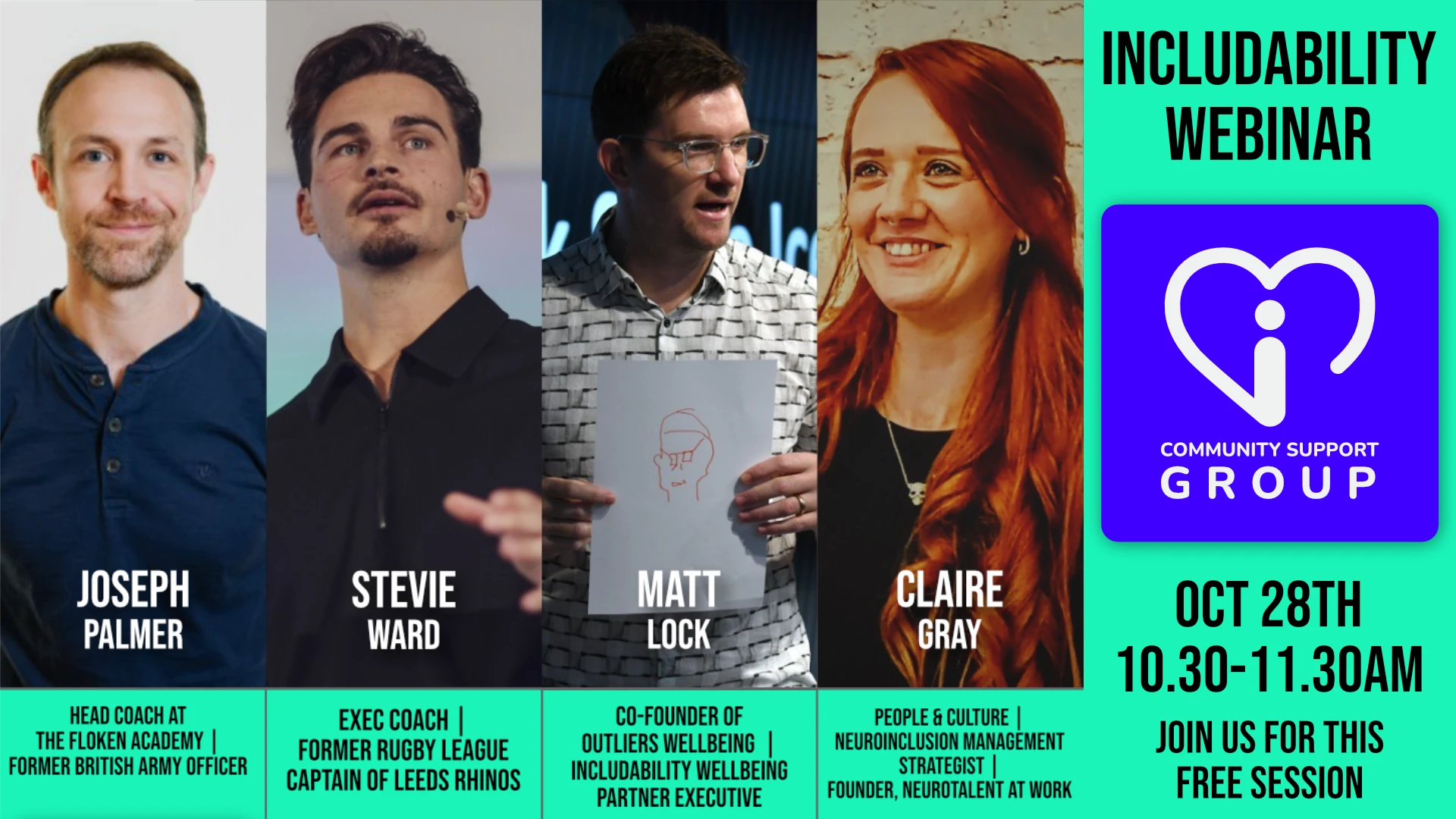
The October Community Support Group, Wednesday 28 October 2026
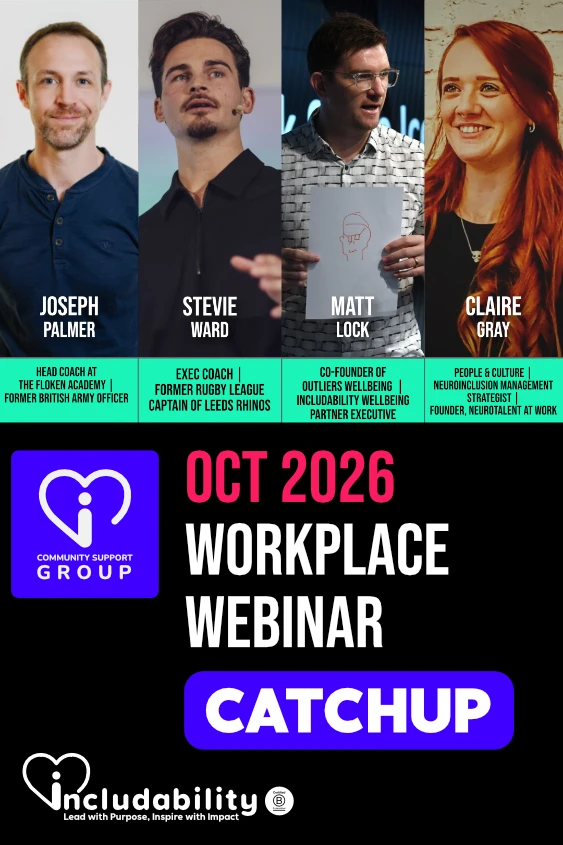
Our October Community Support Group came in two halves. Claire Gray opened with practical answers to the questions line managers ask most about neuro-inclusion. Then Stevie Ward, JP Palmer and Matthew Lock had an honest conversation on men's mental health, to help organisations prepare for Men's Health Awareness Month in November.
Neuro-inclusion for line managers | Claire Gray
Claire Gray, Founder of NeuroTalent at Work
Claire is a neuro-inclusion management strategist. Her work focuses on line managers, many of whom were promoted for being good at their role and given little support for managing people. She took the three questions that come up every time she trains managers and gave a practical answer to each.
- When someone hasn't disclosed. Don't name a condition. Describe what you're seeing and ask how you can help them work at their best. Better still, make "how do you work best?" a standing question in every one-to-one, onboarding and training session, so nobody gets singled out.
- Before a performance conversation. Check whether adjustments have been reviewed. Barriers change, and an adjustment that didn't work may mean the wrong barrier was identified.
- Do adjustments lower the bar? No. Adjustments are a legal duty under the Equality Act, and they level the playing field without changing the standard. For each stage of a recruitment process, write down which job skill it tests. If you can't, change the stage.
Useful links:
A conversation on men's mental health | Stevie Ward, JP Palmer and Matthew Lock
Hosted by Matthew Lock, this conversation looked at the expectations placed on men to be strong and successful, what that does at work, and what courage looks like in practice.
Stevie Ward, Keynote Speaker, Executive Coach and former Leeds Rhinos captain
Stevie founded Mantality, the men's mental health movement, in 2016. He talked about how fear often shows up as control and the need to be right, and how that gets in the way of real connection. As captain at Leeds Rhinos, he helped the team move from a list of values on a wall to behaviours everyone agreed and held each other to, such as picking a teammate up off the ground after a tackle.
Useful links:
Joe "JP" Palmer, Head Coach at The Floken Academy and former British Army Officer
JP served with the Parachute Regiment and the Red Devils freefall team. He talked about grief, and how keeping busy for everyone else meant he never processed it. He also talked about suppressing fear in performance environments, and why courage now looks like texting a mate to ask for a chat.
Useful links:
Matthew Lock, Co-Founder of Outliers Wellbeing and Includability's Wellbeing Partner Expert
Matthew talked about wearing the mask of "the wellbeing guy" while struggling below the surface. His practical point for employers was that organisations say they want psychological safety and human-centred leaders, but manager KPIs rarely point back to culture. If it matters, measure it and reward it.
Useful links:
Questions from the room
Do men use sport or being part of a team to find deep connection and trust?
Often, yes. JP added that this is one reason transitions, ageing and leaving those identities behind can be so hard. One attendee who coaches an under-18s football team said many of his players are looking for connection and a consistent, positive role model.
How can HR help managers encourage men to open up before they reach breaking point?
Sara Matthews, drawing on her time at Chelsea FC, suggested taking people out of the pack for a coffee and an ordinary conversation about how things are going. Matthew added that managers need time for proper one-to-ones, and that organisations should measure and reward that time.
If this conversation brings anything up
- Samaritans, free, 24 hours a day: 116 123
- CALM (Campaign Against Living Miserably): 0800 58 58 58, 5pm to midnight every day
- Your organisation's Mental Health First Aiders or Employee Assistance Programme
What is the Includability Community Support Group?
The Includability Community Support Group is a free monthly online session for HR, People, inclusion, wellbeing and culture professionals, and anyone working to build better workplaces. Hosted by Dave Holby-Wolinski, each session brings together practitioners to share what's working, and the aim is one thing you can take back and use straight away. Speakers educate, they don't sell, and questions go in the chat.
- When: last Wednesday of every month
- Time: 10:30 to 11:30am UK time
- Where: online, on Zoom
- Cost: free, and open to anyone in your organisation
Join the next Community Support Group
Next up: the 2026 Includability Awards
There's no Community Support Group in November. Join us instead for the 2026 Includability Awards, online at 10:30am on Wednesday 25 November.
Register for the 2026 Includability Awards
About Includability
Includability is a UK B Corp workplace culture business. We partner with organisations to build inclusive, diverse, mentally healthy, evidence-based workplace cultures by developing Cultural Roadmaps. A Cultural Roadmap shows an organisation what's working, where the gaps are and what to do next across six pillars: Diversity and Inclusion, Mental Health, Wellbeing, Sustainability and Impact, Talent Management, and Leadership and Governance.

More Episodes in this Category

More From Includability I-Lab

Includability Shorts
Beginners Guides to on your journey to becoming a more committed employer.

Includability Unlocked
Guides to getting the most our Includability

Relive all the best bits from our monthly shows
ESG Catchups
Catch Up with all the latest from our ESG shows from the last Wednesday of every month. Through engaging discussions, enlightening Q&A sessions with expert speakers, and shared best practices, we create a supportive community committed to advancing the standards of workplace inclusivity.


Includability Podcast
Join us as we engage with thought leaders, change-makers, and industry experts who share their insights, experiences, and best practices in equality, diversity, inclusion, environmental and social responsibility, mental health, wellbeing, leadership, and talent management.

Catch Up with special events including our Unleashed Roadshows
Unleashed & Special Events
Through these engaging events, we bring the Includability message to different communities, sparking conversations around our core pillars and inspiring change on a larger scale. Includability Unleashed Roadshows are the ultimate journey into Equality, Diversity, Inclusion, Sustainability, Impact, Veteran Support, Mental Health and all things B Corp!

News & Articles
Includability News & Articles
Our news and articles section is designed to help you find information about all areas of the Includability community. We have collected articles from the experts at the forefront in developing a diverse, inclusive and sustainable world. We have news, expert articles, case studies and advice.
Most organisations have a staff network. Fewer can show what it changed. UK evidence, B Corp JEDI requirements and five actions to make employee resource groups work.
A customer wants your EcoVadis score, the board wants B Corp and ISO 37011 is on its way. Twelve frameworks compared, and how to build evidence once that works for all of them.
Thinking about becoming a B Corp? Here is the full certification process under B Lab's new standards: who can apply, the four steps, the seven Impact Topics, fees, timings, and how to build the Justice, Equity, Diversity and Inclusion evidence an auditor will ask to see.
The talent you need next is often already working for you. The Talent Pooling and Pipelines module helps you find it, develop it fairly and make sure progression is open to everyone, not just the people already in the right conversations.
JEDI
Inclusive recruitment: fairer adverts, selection and onboarding, from first click to first month
Every stage of hiring can widen your talent pool or quietly narrow it. The Inclusive Hiring, Onboarding and Induction module gives you inclusive job adverts, fairer selection methods, an onboarding checklist and guidance on AI in recruitment, from the first advert to the first month in the job.


Sign up for our newsletters
We have an employer and Job seeker newsletter giving you all the latest information in one easy and digestible email. Sign up today for news and job advice straight to your inbox.