
Montagu Evans | An external lens on a strong inclusion agenda

Key Takeaways
- Montagu Evans is an independent property consultancy, founded in 1921, with around 350 people across offices in London, Edinburgh and Manchester.
- Includability delivered Montagu Evans' Cultural Roadmap in July 2026, covering six pillars of workplace culture.
- The Cultural Roadmap drew on a Company Support Survey, six calls with independent Partner Experts and Montagu Evans' own data.
- Montagu Evans is not a B Corp, and its roadmap still included a JEDI Gap Analysis as a benchmark, alongside a Burnout Risk Review.
- After sharing the roadmap with its leadership team, Montagu Evans made recruitment its first focus.
The starting point
Montagu Evans has been owned and run by its partners since 1921. When it became a Committed Employer in 2023, inclusion already had real structure behind it. A Head of DEI reported directly to the executive committee as an independent function. A DEI steering committee brought together heads of department, the HR director, functional directors, non-executives and managing directors, so every part of the business had a voice.
Three networks, Open Circle, Enable:ME and ME:Pride, gave ethnically diverse, disabled and LGBTQ+ colleagues a voice too. The firm had signed the Social Mobility Pledge, the Menopause Workplace Pledge and the Armed Forces Covenant, held Disability Confident Level 2, and was a member of Inclusive Employers and Real Estate Balance. Asked to describe itself in three words, Montagu Evans chose partnership, honest and authentic.
The firm also knew where the gaps were. Leaders were committed, but many colleagues felt neutral to positive about inclusion rather than involved in it, and inclusive leadership was still developing. The plan was to make inclusion more visible and to build a strategy, for inside and outside the business, that was sustainable and accountable. That meant more open engagement through the networks, the launch of Include ME, a calendar of key dates and more internal communication.
Bhavini Shah has since moved into the Head of DE&I role, after a decade as a healthcare property specialist in the firm's Advisory team and four years on its DE&I committee. Her brief is inclusion, and she wanted outside support for the next stage. Giving the leadership team a picture of culture across all six areas was manageable. The firm was proud of its external brand and of the diverse talent it attracts at early careers level.
The harder question was further up the business.
"The hardest part to get a handle on was diverse talent in senior leadership, and supporting diverse talent to progress and thrive in the business." Bhavini Shah, Head of DE&I and Responsible Business, Montagu Evans
What we did together
2023: six expert calls
The partnership began with six calls, one per pillar, each led by an independent Partner Expert. The first, on Diversity and Inclusion, set out where Montagu Evans wanted help: developing the strategy, action planning across the whole organisation, data and insights, and a plan for internal communications.
Since then the team has had access to the wider support that comes with Committed Employer, including monthly Community Support Groups, the client portal, the partner marketplace and our impact and rewards programme.
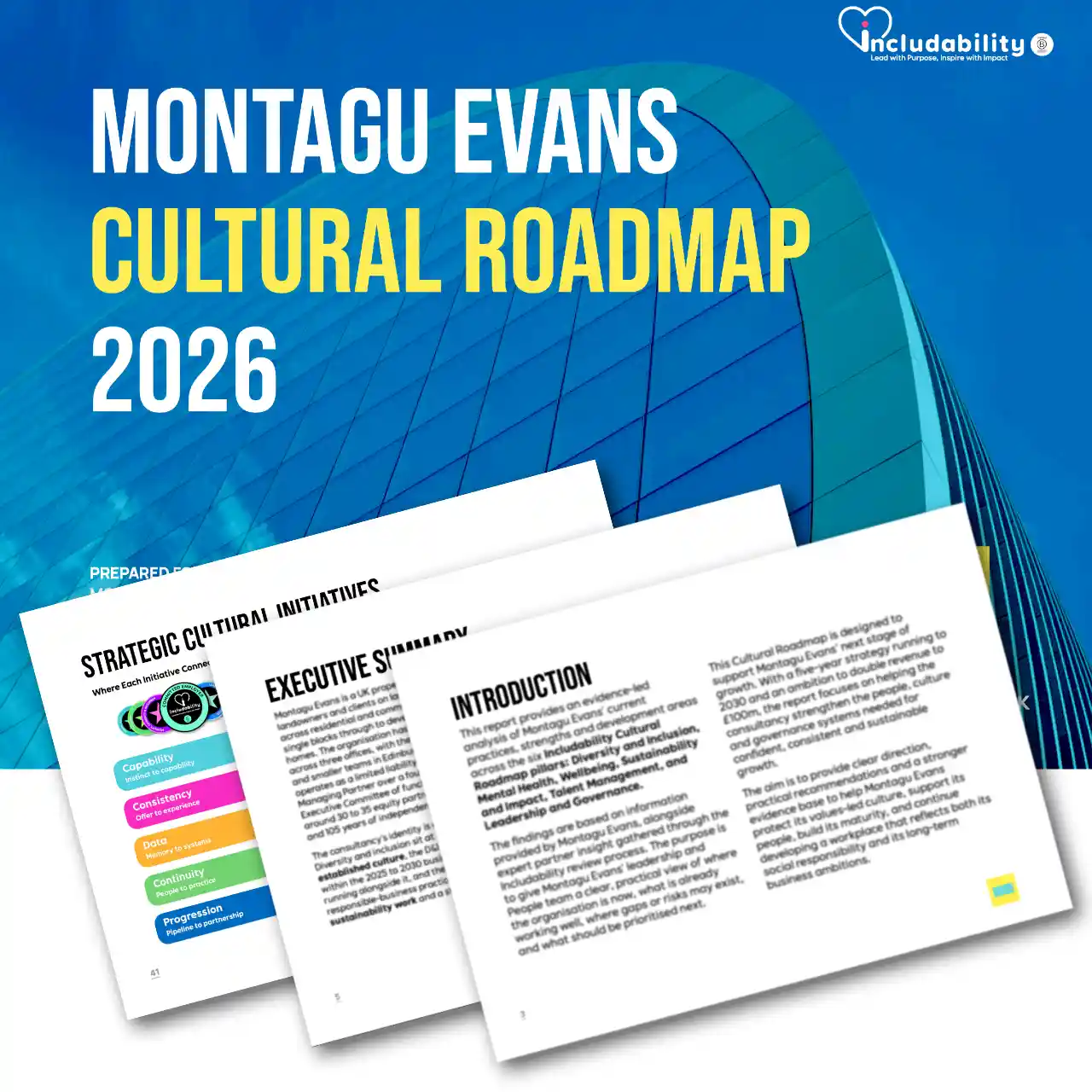
2026: the Cultural Roadmap
The process has grown since 2023. The Cultural Roadmap now adds a survey at the start and a board-ready report at the end, and it drew on three sources of evidence.
- Company Support Survey. A temperature check across all six pillars, so the calls started with us already understanding the business.
- Six expert calls. One per pillar, each led by an independent Partner Expert in that field. Alongside Bhavini, the calls brought in colleagues from the People team and the firm's external sustainability partner.
- Montagu Evans' own data. Policies, workforce data, strategy documents and sustainability reporting.
For a firm that already had a strategy in place, the value was an outside view of it.
"The Cultural Roadmap is a fantastic way to bring an external lens to your policies, practices and processes, and provide guidance on what's working well and areas of recommendation."
What the Cultural Roadmap looks at
Every roadmap covers all six pillars: Diversity and Inclusion, Mental Health, Wellbeing, Sustainability and Impact, Talent Management, and Leadership and Governance. Each pillar is reviewed by an independent Partner Expert working in that field, and each gets the same four lines in the executive summary.
- Maturity level. A written description specific to that organisation.
- Working. What is going well, with the evidence behind it.
- Watch. What is fragile, inconsistent or under pressure.
- Priority. The specific move to make next.
The roadmap then pulls the pillars together into Strategic Cultural Initiatives, the themes that run across several areas, and points to practical support through our marketplace and Academy. Two further reviews sit inside every roadmap.
- Burnout Risk Review. Where growth, workload and change could build pressure, which groups feel it most, and the practical steps that build resilience within teams.
- JEDI Gap Analysis. A map of current practice against the Justice, Equity, Diversity and Inclusion requirements in B Corp's V2 standards, showing where evidence is in place, partial or still to build. Montagu Evans is not a B Corp, so the analysis works as a benchmark for its inclusion work. Each gap links to a section of our JEDI Inclusion Toolkit.
When Bhavini read the roadmap, one thing stood out.
"How much we have to be proud of."
What we see in this sector
Established property consultancies often start from a strong position: long client relationships, loyal people and real pride in their history. The challenges we see sit in how people move through the business.
- Ownership changes slowly. In a partnership the route to partner takes years, so diversity at early careers and technical levels takes time to reach the people who own the business.
- The entry routes are narrow. Many surveyors and planners come through the same degrees and chartered routes, so attraction and hiring are the biggest levers on who joins.
- Managers are promoted for technical skill. Fee-earning work comes first, and people management is often learned on the job.
- Good practice lives with long-serving people. Knowledge held by people with decades in the business is a strength until someone leaves.
- One large office sets the pace. Firms with a big London base and smaller regional teams have to work to make the experience feel the same everywhere.
- Clients ask for evidence. Public sector tenders increasingly ask firms to show their inclusion and social value work, not just describe it.
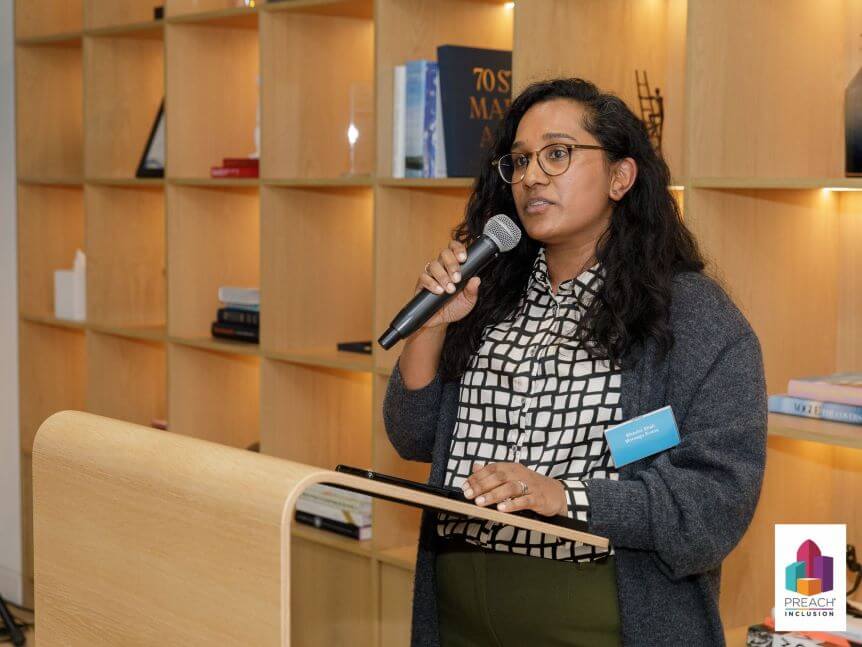
If a peer asked you whether Includability was worth it,
what would you tell them?

Bhavini Shah, Head of DE&I and Responsible Business, Montagu Evans
Shared with the leadership team
Bhavini shared the roadmap with the leadership team, and the response was pride.
"They were also very proud of our achievements."
Starting from what is working gives a leadership team solid ground for the harder conversations. Montagu Evans' roadmap showed its leaders the evidence behind what they had built since 2023, alongside clear recommendations on where to go next.
Starting with recruitment
Montagu Evans has made recruitment its first focus. It links the two ends of the story. The firm is proud of the diverse talent it attracts at early careers level, and its hardest question is how that talent progresses to the top. In a partnership, where the route to partner takes years, who joins today shapes who leads in ten years' time.
Recruitment is also an area where we can help in practical ways. As a Committed Employer, Montagu Evans has unlimited listings on our Inclusive Job Board, with its Committed Employer status shown on every role. The roadmap's recommendations point to specialists in our marketplace and courses in our Academy, and members can use the JEDI Inclusion Toolkit to turn gaps into actions.
Using everything on offer
Bhavini's advice to other organisations is to use every tool available, and that is where the partnership goes next. Alongside the recruitment work, the team has two Burnout Awareness First Aider places each year, whole-team access to our monthly Community Support Groups, and the client portal, with over a thousand hours of recorded sessions.
We will check back in with Bhavini later in the partnership to see how the recruitment work has landed and what the leadership team takes on next.
FAQs
What is a Cultural Roadmap?
A Cultural Roadmap is a board-ready report from Includability that shows where an organisation's workplace culture stands across six pillars and what to prioritise next. It is built from a Company Support Survey, six calls with independent Partner Experts and the organisation's own data.
How long does a Cultural Roadmap take?
The six expert calls are usually completed within six to eight weeks. The roadmap then takes around three to four weeks to build.
Do you need to be a B Corp to have a Cultural Roadmap?
No. Montagu Evans is not a B Corp. Every Cultural Roadmap includes a JEDI Gap Analysis, and for organisations outside B Corp it works as a benchmark for their inclusion work.
What did Montagu Evans do after receiving its Cultural Roadmap?
Montagu Evans shared the roadmap with its leadership team, who were proud of what the firm has achieved, and made recruitment its first focus.